Beyond the blueprint: structuring your offering
Part II in the Branded Residences Series | 8 November 2026
Foreword
When the Maldives reopened its borders in 2020, its luxury resorts welcomed a new kind of guest: the long-stay visitor, treating the villa as a home rather than a holiday.
Developers and operators were quick to see the opportunity: the Maldives resort as a ‘third home’, sold as a branded, managed residence. The pipeline tells its own story. New resorts are being master-planned around residences, existing hotel inventory is being converted for sale, and lagoon developments are offering standalone ‘private islands’ within the resort footprint.
Over the past decade, SHC Law & Tax has advised both developers and buyers on a significant share of the branded residence projects in the Maldives. This guide distils that experience.
For developers, the legal structure is part of the product: it shapes what can be sold, at what price, and how the project performs long after sell-out. This guide, the second in our Branded Residences series and a companion to our Buyer’s Guide, walks through the key decisions from concept to handover.
The strongest projects get the structure right before the first sale – balancing build risk, operator requirements, brand standards and buyer expectations.
Contents
- Foreword
- Structuring the Offering
- Design and Development Considerations
- Construction and Handover
- Payments, Escrow and Delay
- Branding and Management
- Rental Programme and Owners’ Association
- Tax, Finance and Insurance
- Final Thoughts
Structuring the Offering
What the Developer Can Sell
There is no freehold in a Maldives resort. Every resort island or lagoon is leased from the Government under a primary lease – the ‘head lease’ – so the developer itself holds a leasehold interest, usually for a period of 50 years.
What a buyer acquires, therefore, is a strata lease: in effect, a long-term sub-lease of a defined residence, carved out of the developer’s head lease. Marketing materials must make clear as to the nature of the property right being sold.
Everything Flows from the Head Lease
The head lease sits above every residence on the resort. Each strata lease, and the management agreement that must accompany it, ranks beneath it, and any term that conflicts with the head lease simply has no effect.
Expect any serious buyer’s due diligence to start there. Developers should regularise any issues under the head lease before launching sales, including outstanding lease rent or other amounts due to the Government, and any existing breaches or notices. Issues of this kind can delay or prevent registration of the residences with the Ministry of Tourism.
Setting the Strata Lease Term
There is no minimum strata lease term; the term is a commercial decision for the developer. The only constraint is that it cannot run beyond the head lease.
Market practice is to sell the unexpired balance of the head lease’s default 50-year term. A resort ten years into its head lease, for example, would typically offer strata leases of around 40 years.
A head lease can be extended, at the developer’s election, to a cumulative term of 99 years. There is no obligation to take up that extension, or to pass the longer term through to buyers – but a longer strata term is a real value driver, as it:
- supports a higher price point; and
- makes the residence a more liquid asset on resale.
Developers planning to offer longer terms should time the extension election against the sales launch, so the longer term is in place, and priced in, from the first sale.
Off-Plan Sales
Off-plan sales – selling residences before the resort or the unit is complete – are now standard in the market, allowing developers to fund part of the build through pre-sales.
The trade-off is buyer protection: how payments are staged, and what happens if completion slips (see Payments, Escrow and Delay).
Design and Development Considerations
Design Freedom
Developers have a largely free hand on design and allocation – the regulations leave most product decisions to them. That flexibility is valuable, but buyers will benchmark the product against competing projects, not against the regulations.
Key areas left to the developer:
- Size of residence: There is no minimum unit size. The strata lease must state the size of the residence, but the size itself is a product decision.
- Residence common areas: Entirely the developer’s call, but note that:
- residences and their common areas both count towards the built-up area cap (presently 50% of the total land area); and
- where residences are rooms or apartments within a building, the building’s common facilities must be kept separate from the units, with a separate utility supply to the common areas and to each unit.
- Owner access and use: Beyond the owner’s core rights – access to the island, use of the residence and utilities – the law sets no usage regime. The strata lease must set the rules of use for both developer and owner, including the owner’s annual use entitlement (how many nights, and when), particularly where the residence is in a rental programme.
Minimum Product Standards
- Villas. Each villa must have:
- a separate entrance and exit, and more than one room usable as a bedroom;
- an ensuite bathroom to every bedroom, accessible only from that room;
- a living room in addition to the bedrooms;
- its land or lagoon area marked on the site plan; and
- construction to resort standards, with Ministry of Tourism permits.
- One party per unit. Each villa or room can be leased to one party only. That rules out joint ownership and co-ownership structures, though co-buyers can hold through a single company.
- FF&E and OS&E are in unless carved out. A strata lease covers the unit’s fixtures, furniture, operating supplies and equipment. In practice, most branded residences are sold fully furnished to the brand’s standard, which keeps residences consistent across the resort and allows them to enter the rental programme from handover. Developers may offer a choice of brand standard furniture packages. Replacement, refurbishment and funding the FF&E reserve should be addressed in the management agreement and by-laws.
Construction and Handover
Phasing the Build
Most off-plan projects launch sales at the start of construction, so the number of residences built should track realistic absorption, not the most optimistic sales case.
Unsold inventory at handover is expensive. The developer carries the build cost without the pre-sale receipts it was counting on. Defer construction of unsold units instead, and the resort may open with vacant plots next to occupied residences – hurting both the guest experience and how owners see the project.
Defects Liability and Collateral Warranties
On off-plan sales, align the defects liability periods (DLPs) under the construction contracts (EPC or design-and-build) with those given to buyers. If the buyer-facing DLP outlasts the contractor’s, the developer picks up the cost of rectification works itself.
Collateral warranties are worth considering. Though not yet common in the Maldives, a direct warranty from the contractor can help the developer manage buyers’ defect claims. Weigh the cost, though – contractors will price it in.
Managing Variations
Changes to layout, finishes and fit-out – by developer and buyer alike – are inevitable, particularly off-plan.
Sales documents should give the developer room to vary the design, especially to meet Ministry of Tourism requirements. Buyer change requests need firm control, and capping the number of buyer variations is common. Bespoke changes to individual units can disrupt the construction programme, add cost and require amendments to the site plan registered with the Ministry.
Timing the Handover
Construction realities in the Maldives make handover dates hard to guarantee. Almost all materials, fittings and equipment are imported and shipped to remote island sites, so delays anywhere in the supply chain flow directly into the construction programme. The conflict involving Iran in 2026 showed how quickly this can happen; logistical and customs clearance delays held up imports of construction materials for months. We recommend that developers set realistic handover dates with a buffer built in, and that strata leases provide for a handover window rather than a fixed date, with notice to buyers once the resort’s opening is confirmed.
Handover should therefore coincide with the issue of the resort’s operating licence.
A buyer collecting the keys expects to move in straight away, with the resort’s services, staff and facilities fully up and running.
Payments, Escrow and Delay
The Payment Plan
There is no prescribed payment schedule, even for off-plan sales.
Buyers will expect each instalment to be tied to a verifiable construction milestone – foundations, structure, roof, fit-out – rather than to calendar dates alone. Define each milestone precisely, and agree up front how completion will be certified, to avoid disputes over when payments fall due.
Developers should protect themselves equally against buyer default. Contracts should provide for interest on late instalments, a right to terminate after an agreed cure period, and the developer’s right to retain part of the payments made and resell the residence.
When structuring payment schedules, developers should account for tax and foreign currency conversion triggers (see Tax, Finance and Insurance).
Escrow
Escrow is not a legal requirement, but buyers and their advisers may ask for it, particularly on early-stage projects or with developers new to the market.
In a typical arrangement, buyer payments are held by a bank in the Maldives and released to the developer as agreed construction or payment milestones are certified, usually by the engineer appointed under the construction contract.
On a financed project, the lender will have its own requirements on how sales receipts are paid, held and applied. Agree any escrow structure with the lender before offering it to buyers.
Delay and Non-Completion
Given the construction realities discussed in Timing the Handover, fixed handover dates are hard to guarantee in the Maldives. Imported materials, shipping, monsoon weather and the commissioning of resort utilities all put pressure on the programme.
Where a residence is sold before or during construction, the sale documents must set out what happens if the residence does not become operational, and how compensation will be paid.
The regulations leave the remedies, and the level of compensation, to the parties.
Common approaches include:
- delay compensation, payable once handover passes an agreed grace period; and
- a long-stop date (typically six months after scheduled final handover date), after which the buyer may terminate and receive a refund of payments made.
Buyers may also look for protection if the brand exits before the resort opens, since many will have bought on the strength of the brand.
Branding and Management
Choosing the Brand
In the Maldives, the brand is often what the buyer is paying for. A recognised hotel brand de-risks an off-plan purchase in the buyer’s eyes, opens the brand’s global network of high-net-worth customers, and signals consistent service and resale value. In our experience, branded residences command a significant premium over comparable unbranded villas on the market.
A strong hotel flag is not enough on its own. The ‘third home’ buyer often already owns a residence elsewhere and will look for a brand with a proven residences track record, not just a hotel one. Fewer brands have that, and fewer still in the Maldives. Look beyond the name and consider:
- the brand’s track record in selling and managing residences, ideally in comparable resort markets;
- whether the brand has an existing residence owner network it will market to; and
- whether the brand standards are realistic for a remote island build.
Bringing the Operator in Early
In our experience, problems arise when developers launch sales before the brand or operator has been properly consulted. The operator may later object that the residences (especially those in the rental programme) fall short of brand standards, or that the services promised to buyers are ones it is not prepared to deliver. Secure the brand’s and operator’s sign-off on the residence design, sales and marketing materials and management terms before launch.
The Residence Management Agreement
A strata lease cannot stand alone. It must require the buyer to sign a management agreement with the developer, which stays in force for the life of the strata lease.
The management agreement sits between the developer and the buyer – even where a third-party operator runs the resort under a hotel or residences management agreement. The developer therefore answers to owners for the operator’s performance, and owners have no direct claim against the operator.
The strata lease must also set out what happens if the developer assigns its head lease rights, or management of the resort passes to a third party. Plan for this at the outset: a later change of operator or brand is one of the most common triggers for owner disputes.
The Document Suite
Brands and operators will arrive with their standard residence documents. Most map onto the Maldivian structure, but the strata lease and the management agreement must sit at the centre of it.
In many markets the operator contracts directly with owners/ owners’ association. In the Maldives the owner’s contract is with the developer for the life of the strata lease, so the developer always stands between operator and owners.
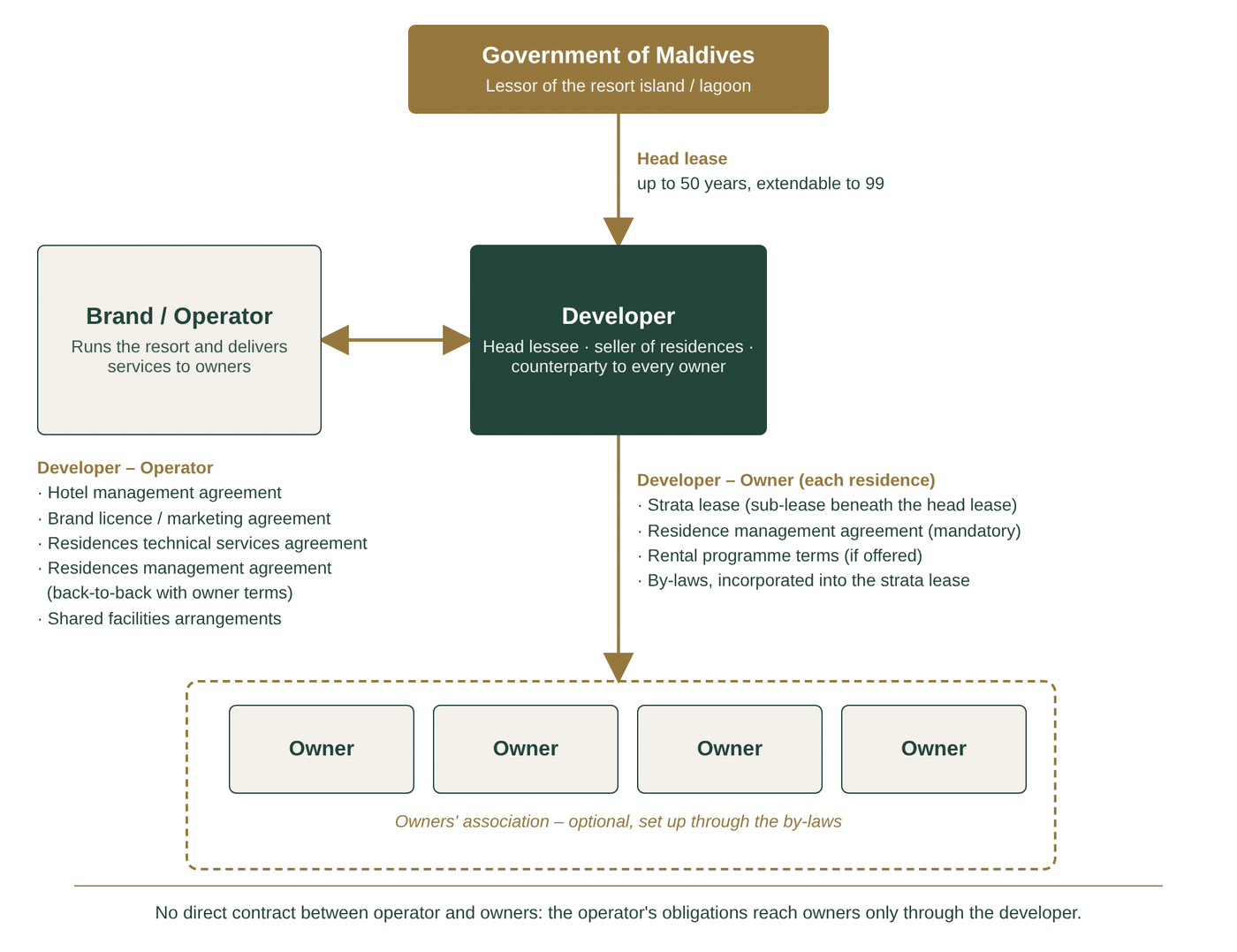
How the contracts fit together on a Maldives branded residence project
Loss of Brand
The brand can be lost for reasons outside the owners’ control. A brand most often withdraws because of a default under the hotel agreements. In practice, the residences cannot be separated from the hotel component: they share the same island, staff, services and facilities, and are usually let through the same rental programme. Loss of the brand for the hotel will therefore almost always mean its loss for the residences too, whatever the residence agreements say.
Sales materials should make clear that the brand is licensed, not guaranteed for the life of the strata lease. The strata lease and management agreement should allow the developer to appoint a replacement operator or brand and set out how owners will be consulted.
Rental Programme and Owners’ Association
The Rental Programme
Owners may not sub-let their residence. They can, however, earn income by placing it in a rental pool (where the developer offers one), with the residence let to resort guests when the owner is not in residence. This is the legal basis for a rental programme.
Whether the rental programme is mandatory or optional is the developer’s call – and one of the most important commercial decisions on the project. A mandatory programme gives the operator reliable inventory and protects brand standards, and operators often insist on it. An optional programme appeals to buyers who want more personal use, but makes rental income less predictable. In our experience, most branded projects in the Maldives opt for a mandatory programme, with owner blackout dates over festive and peak periods.
Both individual and pooled models are in use in the Maldives. Several developers pay each owner what their own villa earns, typically splitting revenue equally with the owner. Others pool revenue among villas of the same type and share it pro rata, which removes disputes over how bookings are allocated but requires a clear formula for owner stays.
Guaranteed rental returns are not the norm in the Maldives, and developers considering one should be cautious.
Owners’ Association
Maldivian law does not require an owners’ association. Each owner’s relationship with the developer runs through their own strata lease and management agreement.
Some developers set one up anyway, particularly on larger projects, as a single channel for owner communications and a forum for decisions on shared costs. Where there is one, the developer sets its rules, voting rights and cost-sharing. The key question is how much control to hand over – especially on service charges, reserve funds and any change of operator.
We recommend governing the owners’ association through residence by-laws, incorporated by reference into the strata lease. With no statutory framework for owners’ associations in the Maldives, the by-laws are what make its rules binding: each owner signs up to them on purchase, and they pass to any later buyer on resale. The by-laws should cover:
- membership and voting rights;
- how meetings are called and decisions made;
- the association’s role in approving budgets, service charges and reserve funds;
- matters reserved to the developer or operator; and
- how the by-laws may be amended.
Tax, Finance and Insurance
Tourism GST
The headline change in the weeks before this guide went to press is the re-introduction of Tourism Goods and Services Tax (TGST) on sales of strata villas (i.e. branded residences). Since late 2024, following a Supreme Court decision, these sales had been exempted. Many developers who priced and contracted on a TGST-free basis are now having to revisit pricing and contracts and reopen discussions with buyers.
TGST now applies at 17% from September 2026, including on outstanding instalments under contracts already signed.
Developers with off-plan sales in progress should review every contract now. Where a contract is silent on new taxes, the developer may have to absorb the cost or negotiate a sharing arrangement with the buyer.
The Foreign Currency Act
Introduced in 2024, the Foreign Currency Act requires certain businesses to convert part of their foreign currency earnings into local currency. Currently, 40% of each month’s foreign currency sales must be converted, within a 28-day window.
Developers should watch the conversion triggers closely:
- tourist resorts are caught automatically, by virtue of their operating licence; and
- any business reaching USD 25 million in foreign currency sales in a calendar year is caught from the following calendar year.
This means a developer can be caught before the resort opens. Strong residence sales in a single year could take the developer over the USD 25 million threshold – and into mandatory conversion – before it holds its operating licence.
Insurance
Insurance of the resort, residences included, is typically placed by the developer as part of its head lease obligations; owners are not legally required to insure their residences separately. The premium is usually recovered from owners through the service charge under the management agreement.
The management agreement and by-laws should set out how premiums are allocated, how insurance proceeds are applied to reinstatement, and whether owners are expected to insure their own contents.
Final Thoughts
The Maldives branded residence market is growing fast. Buyers are better advised, brands are more selective, and the regulatory and tax landscape keeps shifting – most recently with the return of TGST. The developers who succeed treat the legal structure as part of the product, not an afterthought.
Key takeaways for developers:
- Start with the head lease. Its remaining term, consents and conditions set the limits of every residence you sell.
- Confirm the brand and operator before launching sales. Their sign-off on design, sales materials and owner services avoids disputes later.
- Align your contracts. Handover dates, defects liability periods and delay remedies should run back-to-back between your construction contracts and your buyer agreements.
- Time handover with the resort’s operating licence. Owners expect to use their residence from the day they receive the keys.
- Model tax and currency from day one. TGST and the Foreign Currency Act can materially change project returns.
Working with SHC
SHC advises developers, operators, brands and lenders across the full life cycle of a branded residence project – from structuring the offering, head lease and regulatory matters to sales and management documentation, construction contracts and project finance. We would be glad to discuss your project, whether at concept stage or ahead of a sales launch.
For further information, please contact:
Junaina Ahmed
Attorney-at-Law, Partner
junaina.ahmed@shclawyers.com
SHC LAW & TAX LLP is a leading commercial law firm in the Maldives with vast experience in corporate and commercial matters.
We are leading specialists in the sectors of banking and finance, capital markets, hospitality and real estate, and we enjoy a significant market share in the Maldives in these fields.
We have been consistently ranked as a Band 1 commercial law firm in Maldives by Chambers & Partners, IFLR1000 and Asialaw Profiles.
© 2026 SHC Law & Tax LLP. All rights reserved.
The contents of this document are intended as a general guide on the subject matter and should not serve as a substitute for obtaining specific legal advice.
While every care has been taken with the preparation of the document, neither SHC Law & Tax LLP nor the authors accept any responsibility for any loss occasioned by reliance on the contents.